



How to Optimize Cycle Time in 2K Injection Molding
Optimizing cycle time in 2K injection molding involves focusing on three primary areas: maximizing cooling efficiency, reducing mold movement times, and using automation. The single largest component of any molding cycle is cooling. Therefore, it consistently offers the greatest opportunity for significant time reduction. Every second saved in the cycle translates directly into lower part costs and increased production capacity.
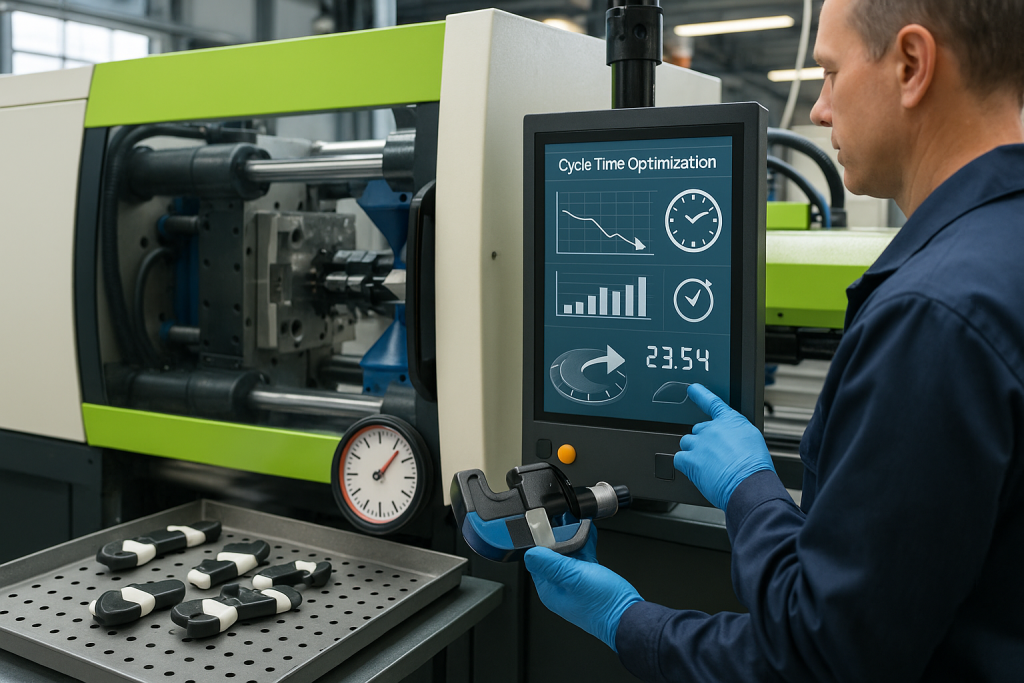
As a manufacturer focused on high-efficiency production, we know that a systematic approach to cycle time reduction is a cornerstone of competitive manufacturing. It is not about rushing the process; it is about engineering efficiency into the part design, the mold, and the machine settings. This transforms manufacturing from a simple operation into a strategic advantage.
This guide will break down the components of a typical 2K molding cycle. We will then explore proven strategies in mold design, material selection, and process optimization that can be used to safely and effectively reduce that cycle time, boosting productivity and lowering costs.
What Are the Components of a 2K Molding Cycle?
To optimize the cycle time, we must first understand where the time is spent. A 2K molding cycle is a sequence of events that repeats to produce each part. In a typical rotary platen process, these events happen in a highly efficient, parallel manner.
- Mold Close and Clamp: The machine closes the two halves of the mold and applies the required clamping force to hold it shut against injection pressure. This is a fixed mechanical time.
- Injection, Pack, and Hold (Shots 1 & 2): This is the heart of the process. In a true 2K machine, the first material is injected to create the substrate at the same time the second material is injected over the substrate from the previous cycle. This parallel action is a major time-saver.
- Cooling Time: This is the longest and most variable phase. It begins the moment the plastic fills the cavity and ends when the part is rigid enough to be ejected without deforming. This time is almost entirely dictated by the thickest section of the part.
- Mold Open, Rotation, and Ejection: The mold opens, the platen or index plate rotates 180 degrees to move the new substrate into the overmold position, and the finished part is ejected. These are all mechanical movements that can be optimized for speed.
Understanding this sequence reveals that while machine movements are important, the cooling phase is where the most significant gains can be made. The entire 2k injection molding process is a race against thermal dynamics.
The Biggest Opportunity: Optimizing Cooling Time
Since cooling can account for over 50% of the total cycle time, any reduction here has a massive impact. Optimizing cooling is a multi-faceted effort that begins with the part design itself and extends to the engineering of the mold.
How Part Design Dictates Cooling
The geometry of the part is the single most important factor determining its cooling time. The golden rule of injection molding design is to maintain a uniform wall thickness. A thick section of plastic acts as a heat sink. It takes much longer for the heat to be extracted from its core, and this single thickest section will define the minimum cooling time for the entire part.
To reduce cooling time, designers should use features like ribs and gussets to add strength and stiffness, rather than thickening the walls. If a thick section is unavoidable, it should be cored out from a non-visible side to create a thinner, more uniform wall. This reduces the mass of material that needs to be cooled, directly shortening the cycle time.
The Critical Role of Mold Cooling Channel Design
The mold acts as a heat exchanger, pulling heat out of the molten plastic. The efficiency of this heat exchange is determined by the design of the cooling channels within the mold steel. A simple mold might just have straight lines drilled through the plates. A high-efficiency mold, however, will have a much more sophisticated cooling layout.
Advanced techniques like conformal cooling are a game-changer for cycle time reduction. Instead of straight lines, these cooling channels are designed to follow the complex 3D contours of the part. This allows the cooling fluid to get much closer to the hot plastic, providing faster and more even heat extraction. While this adds to the initial mold cost, the daily savings from a reduced cycle time can provide a very fast return on investment for high-volume parts.
Material Selection and its Impact
The choice of plastic also plays a significant role. Different polymers have different thermal properties. Amorphous materials like ABS and Polycarbonate tend to release their heat more quickly than semi-crystalline materials like Polypropylene and Nylon, which require more time for their crystal structures to form.
Furthermore, selecting a high-flow grade of a material can help. High-flow materials can be injected at slightly lower melt temperatures. This means there is less total heat that needs to be removed from the mold, which can trim seconds off the cooling time. A deep understanding of 2k injection molding materials is essential for this level of optimization.
Reducing Mechanical and Movement Times
While cooling offers the biggest opportunity, shaving seconds off the mold's mechanical movements can also add up to significant savings over a long production run. This involves optimizing the machine's settings and leveraging automation.
Optimizing Mold Open and Close Speeds
Modern injection molding machines allow for precise control over the mold's movement profile. The platen can be programmed to move very quickly during the main part of its travel and then slow down for the last fraction of an inch for a gentle, safe closing. Fine-tuning these speeds to be as fast as safely possible can trim a second or two from the cycle.
The Impact of the 2K Mechanism
The speed of the transfer mechanism is also key. A modern servo-electric rotary platen can complete its 180-degree rotation much faster and more precisely than an older hydraulic system. The acceleration and deceleration of this rotation can be optimized to be as swift as possible without jarring the newly molded substrate. This is a crucial performance difference when comparing the efficiency of 2k injection molding vs overmolding.
Leveraging Automation for Ejection
Removing the finished part from the mold can be a significant portion of the "mold open" time. Automating this process removes the variability and slowness of a human operator, leading to faster and more consistent cycles. For a broader context, it is helpful to understand the fundamentals of all injection moulding.
- Robotic Part Removal: A servo-driven robot can be programmed to enter the mold, grip the finished part, and exit in a fraction of the time it takes a human. Its movements are identical every single cycle.
- Automatic De-gating: Using gate designs like tunnel (submarine) gates automatically shears the runner from the part during ejection. This eliminates the need for a person to manually trim the gate later.
- In-Mold Assembly/Labeling: For highly advanced applications, robots can perform other tasks like placing an insert or a decorative label into the mold while it is open, consolidating multiple process steps into one.
- Conveyor Systems: Once ejected, the parts should be automatically transported away from the molding area by a conveyor, allowing the machine to begin the next cycle without delay. This is crucial for parts like Soft Touch Grips 2K Molding which are produced in high volumes.
Advanced Processing and Machine Strategies
Beyond the basics, several advanced machine features and processing techniques can be employed to further reduce cycle time. These strategies focus on performing machine functions in parallel rather than in sequence.
Parallel Dosing
Dosing, or plasticizing, is the process of the machine's screw rotating to melt and prepare the plastic for the next shot. On older machines, this happens after the part has cooled and been ejected. Modern machines, however, can perform parallel dosing. This means the screw is already preparing the next shot of plastic during the current part's cooling time. This can save several seconds on every cycle by overlapping these two functions.
Hot Runner Systems
As discussed in runner design, a hot runner system keeps the plastic molten all the way to the part. A cold runner, on the other hand, must be cooled and solidified with the part. Since the runner can often have a significant mass of plastic, eliminating the need to cool it can lead to a major reduction in the overall cooling time and, therefore, the cycle time.
Final Thought
Optimizing cycle time in 2K injection molding is not about pushing machines harder—it is about engineering efficiency into every aspect of the process. Cooling remains the single largest opportunity, where smart part design and advanced mold cooling strategies can shave seconds that compound into massive long-term savings. At the same time, fine-tuning machine movements, adopting faster and more precise transfer systems, and leveraging automation all contribute to a leaner, more reliable cycle.
The manufacturers who succeed in 2K molding are those who approach cycle time reduction holistically—balancing mold design, material science, and process control. By treating every second as an opportunity for improvement, cycle optimization becomes more than a cost-saving measure; it becomes a competitive advantage that directly impacts profitability, quality, and production capacity.
A truly optimized cycle transforms 2K injection molding from a complex process into a streamlined, high-performance system—one where precision, speed, and efficiency work in perfect harmony.
